Electricity Price Increase 2026/27: What 8.76% and 9.01% Mean for Your Bill

Prices and facts checked 16 October 2026. We don't accept payment for rankings.
On this page
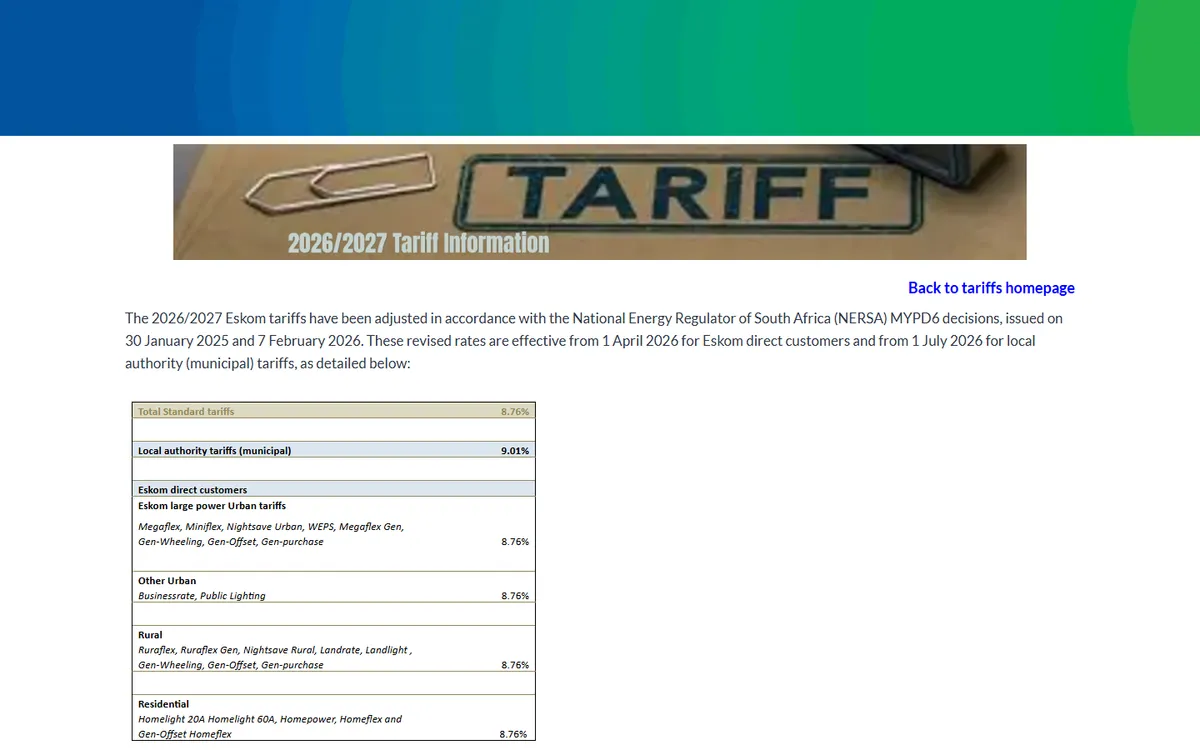
Short answer: NERSA approved an average 8.76% increase for Eskom's direct customers from 1 April 2026, and about 9.01% for municipalities buying from Eskom from 1 July 2026. If you're billed by your municipality, your own increase depends on what your council passed on. For a household spending R1,500 a month, a 9% increase means about R135 more a month, or roughly R1,600 a year (Eskom; Energize).
Check your own supplier. Most households buy electricity from their municipality, not directly from Eskom. Municipal tariffs, fixed charges and free basic electricity rules differ by city. Check your municipality's 2026/27 tariff schedule for exact rates.
The 2026/27 increases at a glance
| Who supplies you | Average increase | From | Until |
|---|---|---|---|
| Eskom direct (you buy from Eskom) | 8.76% | 1 April 2026 | 31 March 2027 |
| Municipality (council buys from Eskom) | 9.01% for municipal bulk purchases | 1 July 2026 | 30 June 2027 |
NERSA approved the increases at its meeting on 5 March 2026 (Energize). Eskom's residential tariffs (Homelight 20A, Homelight 60A, Homepower, Homeflex and Gen-Offset Homeflex) all rise by 8.76% on average for direct customers (Eskom 2026/27 tariff increase). Municipal customers should wait for their municipality's communication on their actual new tariffs (Eskom).
Why the municipal date is later: municipalities change tariffs at the start of their financial year on 1 July, so the Eskom increase reaches municipal customers three months later (Green Building Africa).
Why the timetable moved: a North Gauteng High Court ruling on 21 December 2025 required NERSA to set a revised timetable for 2026/27 tariff applications. Eskom submitted its revised application on 10 February 2026 (Energize).
What it costs in rand
| Monthly electricity spend | +8.76% (Eskom direct) | +9.01% (municipal average) | Extra per year at 9.01% |
|---|---|---|---|
| R800 | +R70 | +R72 | +R865 |
| R1,500 | +R131 | +R135 | +R1,622 |
| R2,500 | +R219 | +R225 | +R2,703 |
| R4,000 | +R350 | +R360 | +R4,325 |
Simple arithmetic on the average increases. Your actual increase depends on your tariff, your fixed charges and how your municipality has structured its own increase.
What else changed: more of your bill is now fixed
Eskom is shifting more of its costs into fixed charges, which you pay regardless of how much electricity you use, and lowering the per-unit (kWh) rates to compensate. According to Eskom's 2026/27 Tariffs and Charges Booklet:
- Homepower and Homeflex: the fixed service and administration charge rose to 66.66% of the originally proposed amount, up from 33.33%. Energy rates were reduced so the total annual increase matches the 8.76% average.
- Generation Capacity Charge: where it applies, it rose to 30% of the originally proposed amount, up from 20%, with energy rates lowered to offset it.
- Homelight stays subsidised. The subsidy is recovered through an affordability subsidy charge on other customers (Eskom).
What it means for you: if you use little electricity, for example because you have solar or a small household, a bigger fixed charge means your bill falls less when you cut usage. Heavy users may see a slightly smaller increase than average, because the per-unit rate has dropped.
Eskom is also planning "Easy Electricity" purchase options for prepaid customers. These aren't new tariffs, but simpler bundles based on average monthly use, and Eskom says the tokens won't expire. Eskom says it will announce when they're available.
How to cut your electricity bill
- Check you're on the right tariff. Low-usage Eskom customers may qualify for Homelight. Ask Eskom or your municipality whether a cheaper residential tariff applies to you.
- Ask about free basic electricity. Many municipalities give qualifying low-income households free basic electricity. Rules vary by city.
- Tackle the biggest users first. Geysers, heaters and pool pumps usually use the most electricity in a home. A geyser timer and blanket, and a lower thermostat setting, are cheap first steps.
- Run the numbers on solar honestly. With more of the bill now fixed, solar saves less on the fixed portion. Compare quotes based on your actual kWh use and current tariff, not the installer's assumptions.
- Prepaid users: buy at a steady pace each month rather than in one big purchase, and keep an eye on your municipality's prepaid rules, which can differ from Eskom's.
FAQ
How much did electricity go up in 2026?
Eskom's direct customers got an average 8.76% increase from 1 April 2026. Municipalities pay Eskom about 9.01% more from 1 July 2026, and set their own increases for households.
When does the municipal electricity increase start?
From 1 July 2026, at the start of municipalities' financial year. Your municipality decides the exact tariff you pay.
Why is my bill going up more than 8.76%?
Your municipality may have passed on a different increase, or changed its fixed charges. On Eskom's Homepower and Homeflex tariffs, a bigger share of the bill is now a fixed charge, so low-usage households may see a larger percentage increase.
Does Homelight still exist?
Yes. Eskom says Homelight remains subsidised, with the subsidy recovered through an affordability subsidy charge.
Will prepaid electricity units expire?
Eskom says tokens bought under its planned Easy Electricity purchase options won't expire. Check with your supplier about other prepaid products.
Sources
Pages we used for this article, checked on or before the update date above.
- Eskom · eskom.co.za
- Energize · energize.co.za
- Eskom 2026/27 tariff increase · eskom.co.za
- Green Building Africa · greenbuildingafrica.co.za
- 2026/27 Tariffs and Charges Booklet · eskom.co.za
Changelog: 16 Oct 2026, first published.