Medical Tax Credits 2026/27: How Much SARS Gives Back on Medical Aid

Prices and facts checked 16 October 2026. We don't accept payment for rankings.

On this page
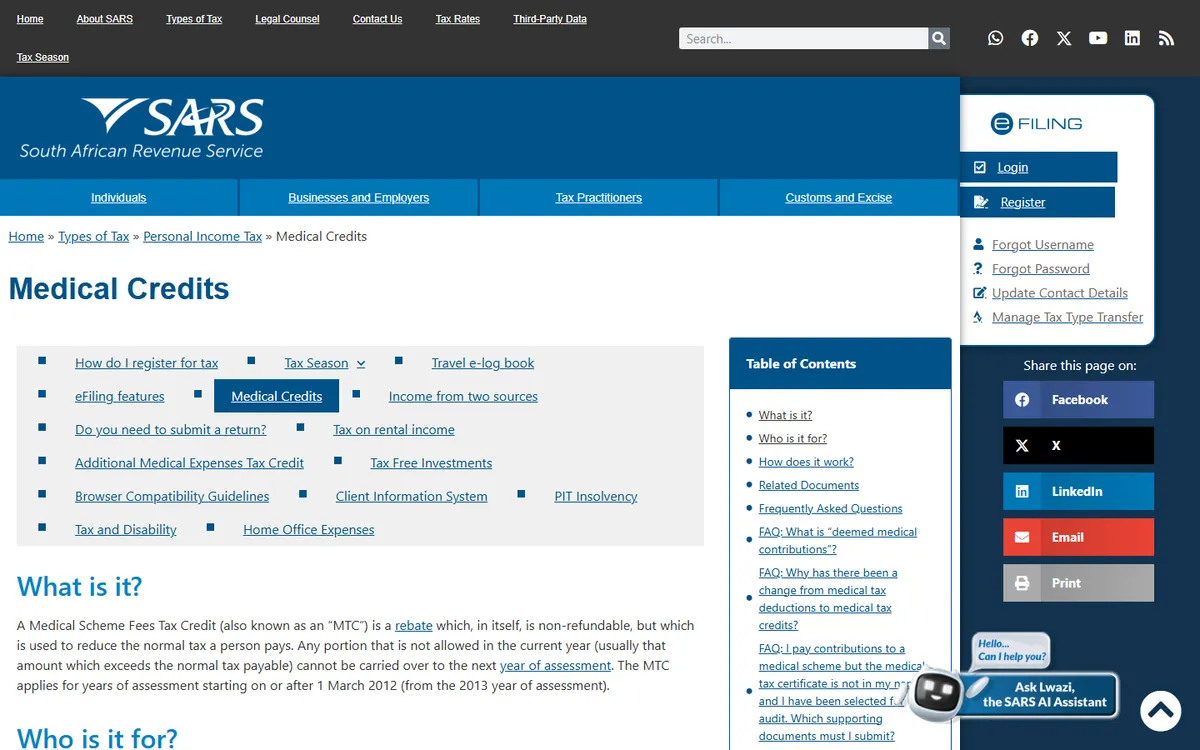
Short answer: for 2026/27, SARS gives you a tax credit of R376 a month for yourself, R376 for your first dependant and R254 for each extra dependant on your medical aid. A family of four gets R1,260 a month (R15,120 a year) off their tax. If your out-of-pocket medical costs are high, you may also qualify for the additional medical expenses tax credit (SARS medical credits; Treasury Budget 2026 tax guide).
General information, not tax advice. The credits depend on who paid the contributions and on your age and disability status. Check your medical scheme tax certificate against your return.
The medical scheme fees tax credit (MTC)
| Who's covered | Monthly credit (2026/27) | Yearly credit |
|---|---|---|
| Main member only | R376 | R4,512 |
| Main member + 1 dependant | R752 | R9,024 |
| Main member + 2 dependants | R1,006 | R12,072 |
| Main member + 3 dependants | R1,260 | R15,120 |
| Each additional dependant | +R254 | +R3,048 |
Source: SARS, checked 16 October 2026.
Key rules from SARS:
- It goes to whoever paid. The credit belongs to the person who paid the medical scheme fees.
- Your employer applies it monthly through PAYE if you pay your contributions through payroll. Pensioners and self-employed people claim it when they file their tax return.
- It can't create a refund on its own, and unused credit doesn't carry over. It only reduces tax you'd otherwise pay. If your income is below the tax threshold (R99,000 a year if you're under 65, according to the SARS 2026/27 tax table), it won't help you that year.
Why it matters: with medical aid prices rising by about 7% to 9% for 2027 (see our medical aid increases guide), the credit covers a shrinking share of your premium. The credit is a fixed rand amount and doesn't grow when your contributions do.
The additional medical expenses tax credit (AMTC)
This second credit helps if you pay a lot towards medical costs: contributions above a set level, plus out-of-pocket expenses your scheme didn't cover. The formula depends on your situation (SARS AMTC page):
If you're 65 or older, or you, your spouse or your child has a disability
33.3% × (medical scheme fees above 3 times your yearly MTC) plus 33.3% × qualifying out-of-pocket expenses.
Everyone else
25% × the amount by which [(medical scheme fees above 4 times your yearly MTC) + qualifying out-of-pocket expenses] exceeds 7.5% of your taxable income.
The 7.5% hurdle means most younger, healthy taxpayers don't qualify unless they have big medical bills in a year.
Worked examples (2026/27)
We calculated these with SARS's formulas. They're illustrations, not tax assessments.
Example 1: under 65, family of two. Medical aid costs R4,000 a month (R48,000 a year). The MTC is R752 a month, or R9,024 a year. Out-of-pocket costs are R15,000, and taxable income is R300,000.
- Fees above 4 × MTC: R48,000 − R36,096 = R11,904
- Plus out-of-pocket: R11,904 + R15,000 = R26,904
- Minus 7.5% of taxable income (R22,500) = R4,404
- AMTC = 25% × R4,404 = about R1,101, on top of the R9,024 MTC.
Example 2: aged 67, couple. Medical aid costs R60,000 a year, the MTC is R9,024 a year and out-of-pocket costs are R20,000.
- Fees above 3 × MTC: R60,000 − R27,072 = R32,928 → 33.3% = R10,965
- Plus 33.3% × R20,000 = R6,660
- AMTC = about R17,625, on top of the R9,024 MTC.
What counts as qualifying medical expenses?
These are amounts you paid yourself that your medical scheme didn't refund, for example co-payments and shortfalls on claims. Keep invoices and proof of payment. SARS may ask for them in a verification (SARS refund delays).
How to claim
- Download your medical scheme's tax certificate. Schemes issue one each year, and SARS usually pre-fills it on your return.
- Add out-of-pocket expenses in the medical section of your ITR12 if you want SARS to consider the additional credit.
- Check who's listed as the payer. If a parent pays for an adult child's cover, the parent claims.
- File by the deadline. Non-provisional taxpayers file by 23 October 2026 for the 2026 tax year (SARS filing season).
FAQ
How much is the medical tax credit for 2026/27?
R376 a month for the main member, R376 for the first dependant, and R254 a month for each additional dependant.
Do I get the medical tax credit if I'm not working?
Only if you pay tax. The credit reduces tax but isn't paid out as cash, and unused credit is lost.
Can I claim medical expenses my scheme didn't pay?
Yes, through the additional medical expenses tax credit, but for most people under 65 only the part above 7.5% of taxable income counts.
Can two people claim the credit for the same medical aid?
No. SARS gives the credit to the person who paid the medical scheme fees. Check who's shown as the payer on the scheme's tax certificate.
Is gap cover covered by the medical tax credit?
No. The credit applies to medical scheme fees. Gap cover is an insurance product. See our gap cover guide.
Sources
Pages we used for this article, checked on or before the update date above.
- SARS medical credits · sars.gov.za
- Treasury Budget 2026 tax guide · treasury.gov.za
- SARS 2026/27 tax table · sars.gov.za
- SARS AMTC page · sars.gov.za
- SARS filing season · sars.gov.za
Changelog: 16 Oct 2026, first published with the 2026/27 credit amounts.