SARS Filing Season 2026: The 23 October Deadline and What Happens If You Miss It

Prices and facts checked 15 October 2026. We don't accept payment for rankings.
On this page
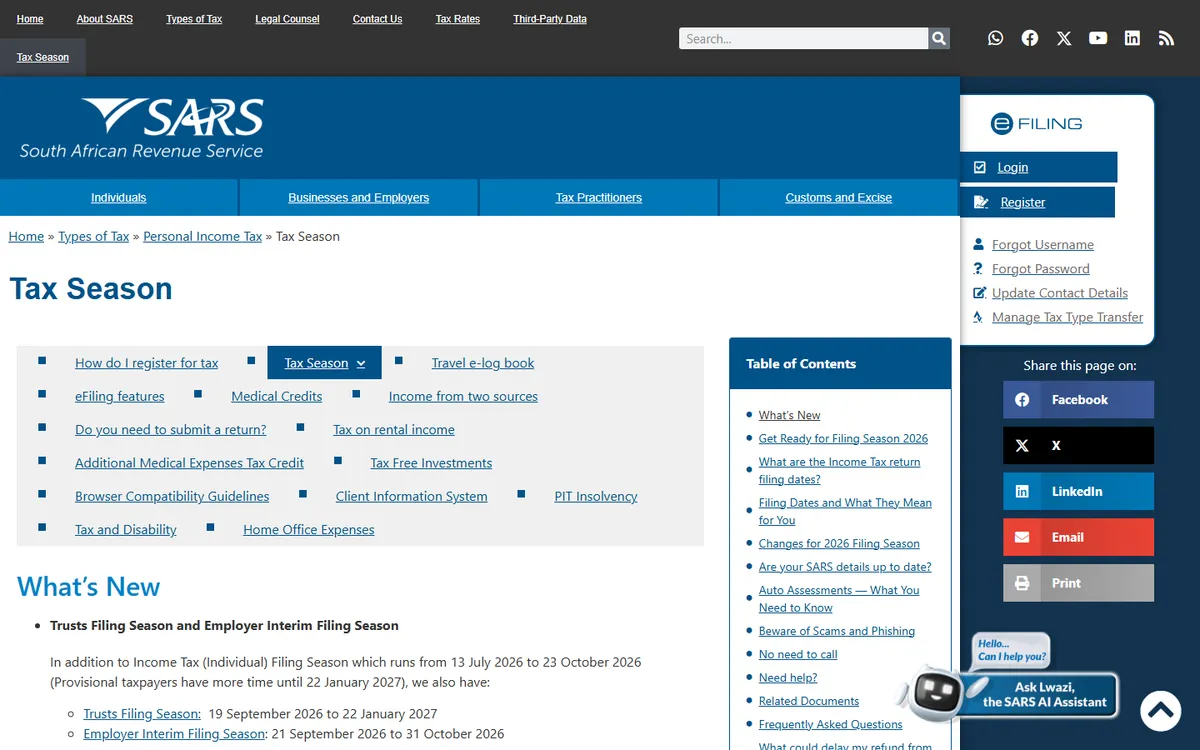
Short answer: if you're a non-provisional taxpayer (most salaried employees), your 2026 tax return is due by Friday, 23 October 2026. Provisional taxpayers and trusts have until Friday, 22 January 2027. If you were auto-assessed and agree with it, you don't need to do anything. If you need to change your auto-assessment, the cut-off is also 23 October (SARS filing season page; SARS auto-assessment page).
General information, not tax advice. This guide summarises SARS's published rules for the 2026 year of assessment (1 March 2025 to 28 February 2026). For your own situation, check eFiling or speak to a registered tax practitioner.
The 2026 filing season dates
| What | Dates |
|---|---|
| Auto-assessments sent out | 1 to 12 July 2026 |
| Filing opens for individuals | 13 July 2026 |
| Non-provisional individuals: deadline | Friday, 23 October 2026 |
| Trusts filing season | 19 September 2026 to 22 January 2027 |
| Provisional individuals and trusts: deadline | Friday, 22 January 2027 |
Source: SARS filing season page, checked 15 October 2026. The dates are set in Government Notice 7422 (Government Gazette 54598 of 30 April 2026), as reported by Moonstone.
Are you provisional or non-provisional? SARS describes non-provisional taxpayers as people who usually earn a salary with PAYE deducted and have simple tax affairs. Provisional taxpayers earn other income too, such as business, freelance, investment or rental income, and pay tax in advance during the year (SARS).
Do you have to file at all?
Not everyone does. According to the 2026 notice, as summarised by Moonstone, you don't need to file if your gross income for the year was made up only of:
- a salary of R500,000 or less from a single employer, with PAYE deducted;
- South African interest of up to R23,800 (under 65) or R34,500 (65 and older), not counting tax-free investments;
- amounts from tax-free investments;
- one retirement fund lump sum, taxed under a tax directive.
These exemptions fall away if you received a travel, accommodation or subsistence allowance, a taxable company car benefit, or pay for work done outside South Africa.
You must file if, for example, you ran a business or side hustle (trading other than as an employee), had capital gains or losses over R40,000, held foreign assets worth more than R250,000, or earned more than the basic threshold for your age (R95,750 under 65). You must also file if SARS asked you to.
Not sure? SARS has a Do you need to submit a return? questionnaire. SARS's own advice is that if you're uncertain, you should file.
If you were auto-assessed
Between 1 and 12 July, SARS sent auto-assessments to taxpayers with simple affairs. These were built from data supplied by employers, medical schemes, banks and retirement funds. SARS says that if you didn't get an SMS or email by 12 July 2026, you weren't auto-assessed (SARS).
- You agree with it: there's nothing more to do. SARS says refunds of R100 or more are paid automatically, usually within 72 hours (SARS auto-assessment page).
- Something's missing or wrong (such as a retirement annuity contribution, medical costs or a second income): change and submit your return on eFiling or the SARS MobiApp on or before 23 October 2026.
- You missed that window: you can still dispute an assessment through the formal dispute process, which SARS says must be started within 80 business days of the assessment date (SARS: What if I do not agree?).
What happens if you miss the deadline
If you have to file and don't, SARS can charge a fixed monthly administrative penalty for each outstanding return. SARS says it ranges from R250 to R16,000 a month, depending on your taxable income, for every month you remain non-compliant (SARS FAQ on administrative penalties).
SARS's FAQ doesn't publish the bracket table. Sage South Africa lists it as follows (based on your taxable income or assessed loss for the previous year):
| Taxable income | Penalty per month, per return |
|---|---|
| Up to R250,000 | R250 |
| R250,000 to R500,000 | R500 |
| R500,000 to R1 million | R1,000 |
| R1 million to R5 million | R2,000 |
| R5 million to R10 million | R4,000 |
| R10 million to R50 million | R8,000 |
| Over R50 million | R16,000 |
Two things make this expensive:
- One late return is enough. Since December 2022, SARS charges the penalty for a single outstanding return. Before that, it needed two or more (BusinessTech).
- It keeps running. The penalty repeats every month for up to 35 months, or 47 months if SARS doesn't have your current address (Sage). For someone earning R400,000, that could add up to R500 × 35 = R17,500 on one return.
If you've already been penalised, file the outstanding return first. Then you can submit a Request for Remission, which SARS is more likely to grant for a first offence or in exceptional circumstances such as serious illness (Sage).
What to do this week
- Check your status. Log in to eFiling or the SARS MobiApp, or use SARS's online auto-assessment status lookup linked from the filing season page.
- Gather your documents. You'll need your IRP5 from your employer, your medical aid tax certificate, retirement annuity certificates (IT3(f)), and IT3(b) interest certificates from your bank.
- Check the pre-filled figures. SARS pre-populates most returns. Compare them with your certificates, because missing RA or medical deductions are the usual reason people pay too much.
- Submit by 23 October. Don't leave it for the last evening, when eFiling is busiest.
- Watch out for scams. SARS warns about phishing emails and SMSes during filing season. Only log in through the official eFiling site or app (SARS).
FAQ
When is the SARS deadline for 2026?
Friday, 23 October 2026 for non-provisional individual taxpayers, and Friday, 22 January 2027 for provisional taxpayers and trusts.
I was auto-assessed. Do I need to do anything?
Only if the assessment is wrong or incomplete. If you agree with it, SARS says there's nothing more to do, and any refund is paid automatically. If you need to change it, submit an updated return by 23 October 2026.
I earn under R500,000. Do I need to file?
Not if your only income was a salary from one employer, with PAYE deducted, and no allowances or company car benefit, plus interest under the limits. If you changed jobs during the year, had a side income or want to claim deductions (such as a retirement annuity), you should file.
What is the penalty for filing late?
A fixed monthly penalty for each outstanding return, from R250 to R16,000 depending on your taxable income. It can run for up to 35 months.
Can I still file after 23 October?
Yes. eFiling stays open and you should file as soon as possible, but you may be charged the administrative penalty. Filing late is better than not filing, because the penalty keeps adding up each month.
Can SARS extend the deadline?
Deadlines are set in the annual Government Gazette notice. Individual extensions aren't something to rely on. Plan to file on time.
Sources
Pages we used for this article, checked on or before the update date above.
- SARS filing season page · sars.gov.za
- SARS auto-assessment page · sars.gov.za
- Moonstone · moonstone.co.za
- Do you need to submit a return? questionnaire · sars.gov.za
- SARS: What if I do not agree? · sars.gov.za
- SARS FAQ on administrative penalties · sars.gov.za
- Sage South Africa · sage.com
- BusinessTech · businesstech.co.za
- eFiling · sarsefiling.co.za
Changelog: 15 Oct 2026, first published.